We have all heard the virtues of “persevering against all odds” and eventual triumph of the protagonist. But is it always the case, are there legit scenarios where cutting your losses early could be more advantageous and if there are; how one goes about thinking through these situations in the moment. This book prescribes just that – Annie Duke’s second book titled “Quit” covers such a less talked about scenario. Her earlier book titled “Thinking in Bets” offers an equally practicable advice on how to take decision in probabilities, I would cover that book some other time
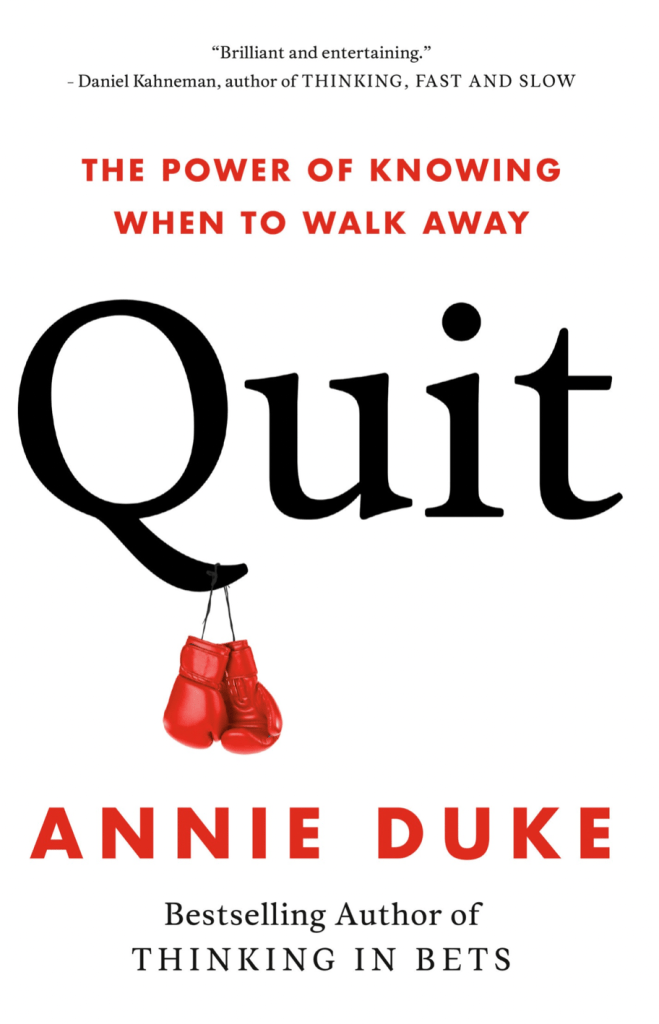
The main premise of the book is centred around asserting that success does not lie in sticking to things. It lies in picking the right thing to stick to and quitting the rest. In fact one can argue that quitting provides one an ability to react the way the world has changed, knowledge about self or others has changed. Having the option to quit allows one to walk away when it’s found that the thing being done is broken! An important point the author emphasises is that sticking with a course of action is the only way to find out for sure how it will turn out. Therefore quitting requires being okay with not knowing what might have been
When to Quit and how to “price” quitting?
You should quit, when you still have a choice. Quitting on time will usually feel like quitting too early because we tend to rationalise the status quo because of our aversion to quitting. Therefore as a heuristic, if you feel like you’ve got a close call between quitting and persevering, it’s likely that quitting is the better choice. When the time is objectively right to quit, nothing particularly urgent will be happening right at that moment. The hardest quitting decisions are often about who you are i.e. related to identity and dissonance
Fundamentally quitting decisions are expected value decisions however the expected value is not just about money. It can be measured in health, well-being, happiness, time, self-fulfilment, satisfaction in relationships, or anything else that affects you
So why don’t most people follow this simple heuristic to quit in time?
Loss aversion, sunk cost fallacy, endowment effect, status quo bias, over-optimism, goal orientation and escalation of commitment are typical mental biases which come in the way of identifying the right time to quit and importantly acting on it. The last one is especially tricky because it doesn’t just occur in high-stakes situations. Escalation of commitment also happens when the stakes are low, demonstrating the pervasiveness of the error. Establishing a clear pre-determined “kill criteria” to trigger a quitting decision is a very good tactic to avoid these biases and effecting quitting at the right time e.g. a good kill criterion is the turnaround time on Everest. Let’s say if you haven’t made it to the summit by 1 p.m., you cannot safely descend to Camp 4 before dark, so you must abandon the climb
If you want to be a good quitter, as Daniel Kahneman told the author, all you need is a friend who really loves you but does not care much about hurting feelings in the moment. Then listen to that person with intent to act! Remember as Annie argues in the book “when you say, “I’m just not ready to decide yet,” what you are really saying is, “For now, I am choosing the status quo.”
It’s a great practicable read, I would definitely recommend it! So what is the kill criterion for you in the most pressing decisions you are currently making?
 The Learning Curve: Interesting Readings for Product Leaders